Ghost In The Machine
Intrigued by the idea of a post-apocalyptic game that offers up a slightly more optimistic view of life after the fall John Power caught up with the team behind expansive and ambitious new RPG Dreams and Machines.

Intrigued by the idea of a post-apocalyptic game that offers up a slightly more optimistic view of life after the fall John Power caught up with the team behind expansive and ambitious new RPG Dreams and Machines.
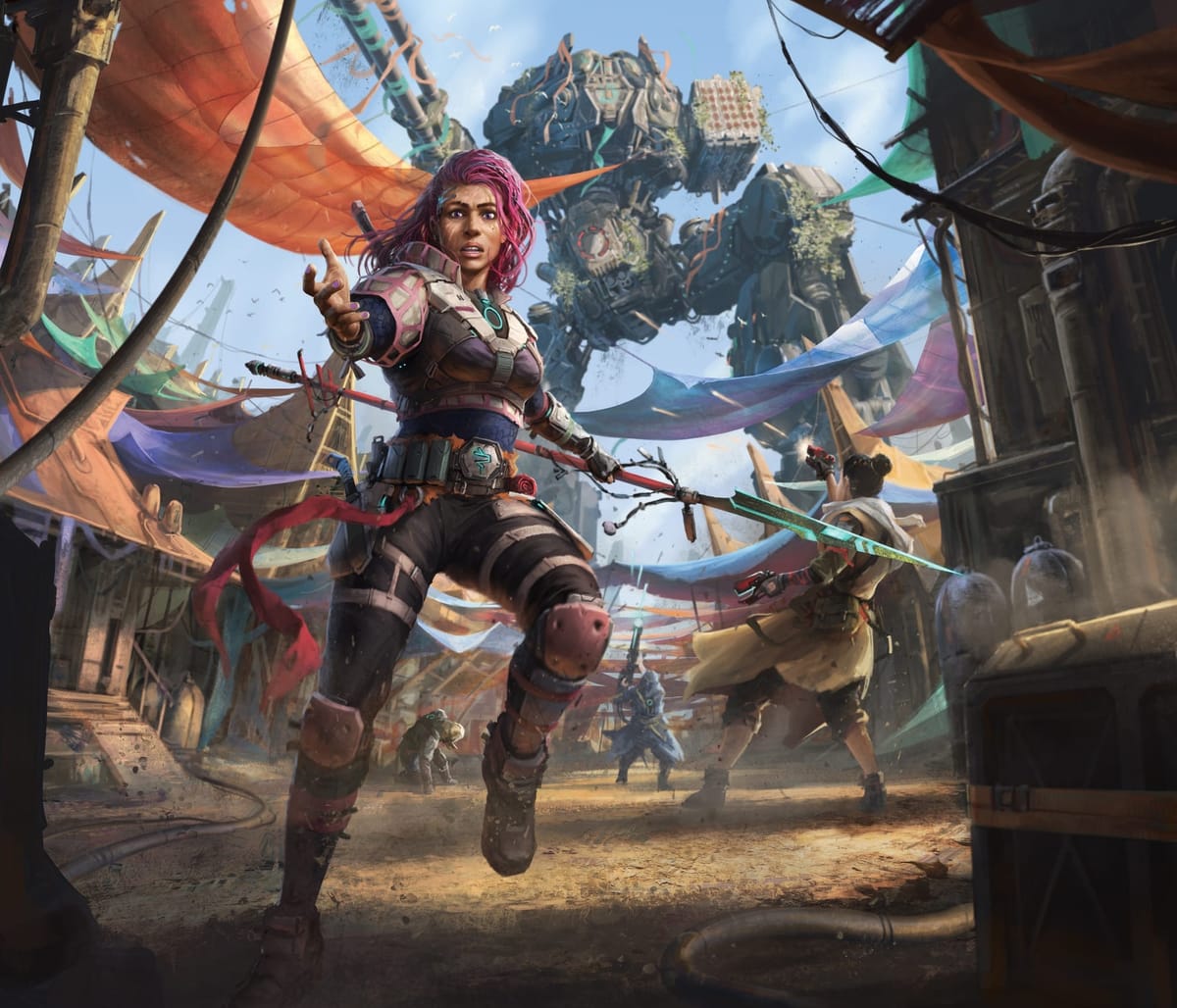
As humanity half stumbles, half gleefully sprints towards a number of possible extinction level events, the role that Artificial Intelligence will play in our doom is being increasingly scrutinised. As it stands what passes for AI will more likely hasten the end through the obscene demands it places on our resources than by sending killer robots after us but, whether its silicon malice or our own stupidity, AI apocalypses are very much the topic du jour, making the release of Dreams and Machines timely indeed.
A new RPG from Modiphius, the game takes place on Evera Prime, a distant planet colonised by humans and now cut off from the home-world. As it happens isolation would be only the start of the Everans problems. Having speedrun the whole warring nation states become a unified global authority thing, their new techno utopia would come to a crashing halt as, surprise surprise, the Builder -the AI system built to make life so sweet- did what AI systems do best and promptly tried to wipe them out.
If that sounds at all derivative well the good news is that there’s actually a lot more weird stuff bubbling away under the hood of Dreams & Machines. From the various philosophically inclined factions who existed, and maybe still do, before the war to what actually made The Builder go rogue in the first place there’s lots of interesting ideas to explore. Importantly though none of that is required reading to start playing as the game takes place a good two centuries or so after the war (humans won at a terrible cost in case you wondered) when new communities are emerging amongst the ruins of the past.
Dreams & Machines then is less about desperate last stands and more about rebuilding society after a fall. Life on Evera Prime may be hard but this is not a relentlessly grim might-is-right world where tyrant warlords rule over feral gangs of cannibal halflings. Rather this is a game about community and finding strength in others, about trying to build a better world and trying to not repeat the mistakes of the past.
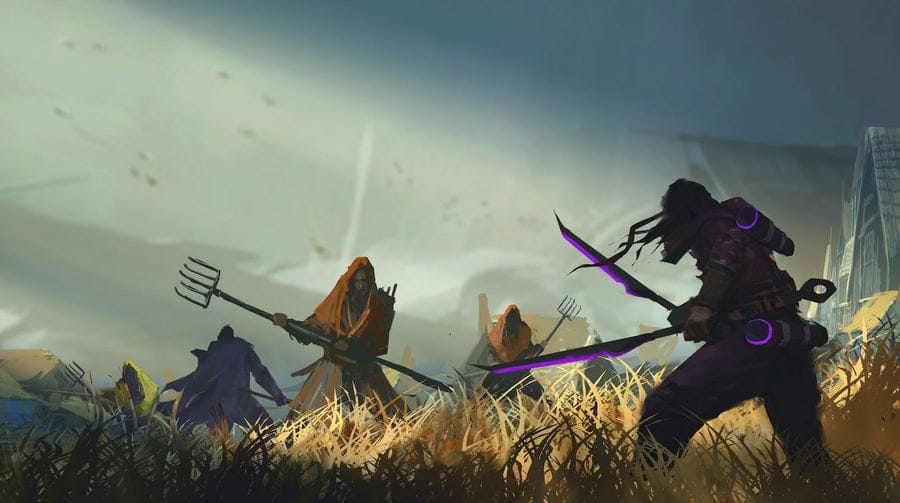
Now, if that all sounds just a little happy-clappy for you, or worse like some Lib Dem local council simulator, it is worth noting that Dreams & Machines is also very much a game about exploring trog filled under-cities and fighting the giant murder machines that occasionally stir from their digital dreams and embark on terrifying rampages. See maybe we can have it all.
The game is the child of Modiphius CEO Chris Birch, and much as it might surf the zeitgeist is something that has been percolating in the back of his mind for almost as long as he’s been slinging dice.
‘Probably ever since the second role playing game I played,’ Birch recalls. ‘My brother was running it and I was sent out on a mission from our village. I came upon this big metal wall which went up to the sky and there was this kind of “oh my God!” moment where I realized I was on a spaceship. It was a game called Metamorphosis Alpha, this kind of pre-Gamma World post-apocalyptic sci-fi game set on a spaceship. I think it was TSR’s second RPG.
‘After that I've always had this love for post-apocalyptic worlds. But those early, kind of gonzo, post-apocalyptic games were not depressing, they were just kind of mad and crazy with bright artwork and whilst often you died quite quickly it wasn't it wasn't all dark and grim.
‘And then I've always loved zombie films and TV shows like The Walking Dead, that was great but it became so much about how horrible human beings can be to each other. Let's double down on that in the next series and then the next series. So I've been dreaming about doing something in the genre for years but something that was more hopeful. And I have this sort of thing that when someone says, “well, you can't do that, that's not what post-apocalypse is,” it pushes me to come up with something.’
That something was initially a story, a story about a little girl called Kari who grows up in a world where robots once killed a lot of people. And in that little girl’s garden is an old, long dormant robot that birds nest in and she would play under it, until one day the robot woke up and instead of rending the little girl limb from limb, the two would become friends and set off to explore the ruined world together.
It sounds a little like if Michael Rosen had been rebooted The Terminator franchise, which going by recent efforts wouldn’t be a bad thing. Anyway, from this beginning he began to develop more characters to explore this world and importantly invite more people to play in it with him. Much as this is clearly a passion project for him, he’s keen to stress the importance of collaboration to bring something like this to life.
’At some point you always have to give things up, and if you don't it's probably not going to go very far. And also, I'm a white guy with a beard trying to write a story about a girl and a robot. So right at the beginning we brought in Amanda Harmon to help with building some of the world. She ended up going to work at Wizards [of the Coast] so then we brought in several more women to really help flesh out the story and I thought let's just get totally different perspectives in to help develop the world and the various factions.’
In Dreams and Machines those different factions are the communities that have banded together after the war and over the years developed their own customs, identities and distinct way of life. At character creation players can choose from one five, Everans, Dreamers, Archivists, Spears or Rivers, which help define your background, starting attributes, special abilities and importantly connection to the world around them.
Birch uses the Spear faction as an example of how the team built upon his ideas. ‘They're a bit like the the people who live in Kharkiv and won't leave even though the Russians are bombing it. So when the robots started turning on everyone these were the people who were like “no, I'm gonna stay and fight for my community, whatever.” Most were killed but the ones that got lucky and survived became this group called the Spears. They’re the people who ended up living in the most irradiated bio-contaminated parts of the ancient ruins and they've suffered a lot for it. They may have a lot of disabilities, a lot of a lot of health problems, but they're tough, they know how to hunt machines and it's part of their culture now.
‘So with the Spears I really only had a few paragraphs about this concept and these got handed over to an amazing writer, Logan Boese. He worked on Coyote & Crow and he really added so much flavour to the Spears. He came up with the idea that they they didn't leave anyone behind but that doesn’t just mean that they always carry the wounded home but that no one feels lesser in their society than anyone else. If someone’s missing a leg, they’d figure out a prosthetic for them. If someone has breathing difficulties they'd they'd figure out a breathing mask. So everyone feels equal and it doesn't matter what their disability might be, so in the game you can have a prosthetic leg and there's no there's no rules difference, you are the same as everyone else.
‘So, kind of, grudgingly handing over all the different parts of the world has been great because I've seen people add stuff to it that I'd never have thought of myself and its come to life. Hopefully good bosses surround themselves with people who are better than them. And I like to think that a lot of the writers who've worked on this are way better than me and added a lot more dimensions to the world to make it feel more real. I was just the dotted line on the map that they've all followed to bring some real character to this world and now we've got all these factions that actually feel like they're believable groups of people as opposed to just a few interesting sentences.’
In recent years Modiphius has enjoyed considerable success with RPGs based on existing properties, publishing games such as Dune: Adventures In The Imperium, Fallout, Star Trek Adventures and with a game based on Terry Pratchett’s Discworld novels currently in development. When you see the amount of world building that has gone into Dreams and Machines -both the core rulebooks and starter set are stacked full of background material, short stories and artwork- it’s easy to understand why licensing an IP, with both a ready made setting and pre-existing fanbase, might be preferable.
With Dreams and Machines though Modiphius seem keen to reverse engineer that process. When the game was first announced there was talk of an accompanying miniatures game, board games, novels and maybe even somewhere down the line a TV series. Birch seems sure that all the investment is worth it.
‘I think what's important is that when you you create an IP like this, you’ve got to think about where it could end up,’ he explains. ‘So that's why there's a story about a girl and a robot, because that's what you'd pitch to TV and film. And so as we evolve the setting, as we fill in the gaps that pitch gets easier and easier. We're not pitching it to TV now because we want to get the brand more established, but we're on track so that at some point we would do a treatment with a script writer and then pitch it to producers.
‘A lot of role playing settings don't have any characters. They don't have any kind of strong personal story that could become something that's not just a tabletop game. I mean, it doesn't have to be an all encompassing IP, a game can just be a good little game. If you are doing an all encompassing thing there's a lot more work involved in the background to really think about what it is you're making, and what media you can commit to. It's relatively easy for us to do fiction, it's just more writing. But we've had people pitch me why don't you do a Kickstarter for for a film? Well because when we're not a film company, and we'd just end up spending stupid amounts of money trying to make a film and then not make games, which is what we're better at.
‘So we've got other games, like Five Parsecs From home a great little procedurally generated RPG, and we might do more with them in the long run, but at the moment, they're just great little games that actually don't want to go into too much detail and be too prescriptive. Obviously it's brilliant working on licenses, because it's stuff that you maybe have always dreamed of working with, but it's also brilliant being able to create something original. And from a business perspective, if I spend 20 or 30 grand on our own IP, that's investment in value. I don't get that back from Star Trek, because they’ll own all the artwork and writing at the end of the day.’
If TV shows and films are still some way away, things are already moving on other fronts with a novella -expanding on the story of Kari and her robot- on the way, a range of miniatures in production and they have already followed up the release of the Starter Set and Player’s and Game Master’s Guides with a GM Toolkit and later this summer the game’s first Setting Guide, a deep dive into the ruined city of Emerta Valo.
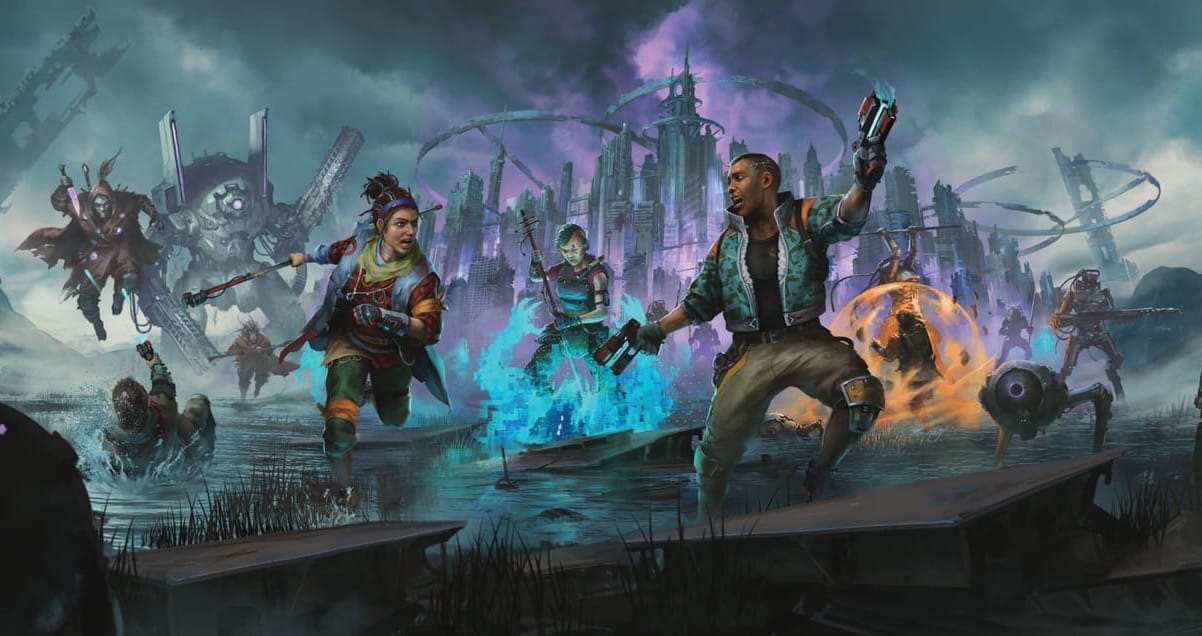
Returning to the game itself, those familiar with Modiphius’s other RPGs should be able to jump straight in as it runs on their in-house 2d20 system, as used in games like Achtung! Cthulhu, Fallout and Star Trek Adventures. Like most RPG systems these days that don’t come with an ampersand it’s a system that’s reasonably quick to get a hold of as the Modiphius’s product manager, Samantha Webb is keen to tell us.
‘2d20 really is simpler than the most popular role playing game in the world because it's really just about number recognition, so you don't really have to do any maths,’ explains Webb. ‘You only need to add together the relevant attribute and skill value that you’re using to get a number you must roll under. You roll a pool of D20s, by default that’s 2 hence the name but you can possibly roll up to three more, and your GM is going to ask you for a number of successes depending on the difficulty of the task.’
‘I’ve played 2d20 a lot and particularly GMed it a lot and the way that I think it really elevates itself above a lot of the other systems is you can use the mechanics to ramp up the tension in a very tangible, very visceral way. So I show that aspect of it in my Star Trek Adventures stream on our Twitch channel. There I'll be framing the scene, framing what the character wants to do in the context and the difficulty that it's going to take them. If you tell people they need five, six successes in order to pass this test, immediately they're like, “Oh my god, how am I going to do this?” But because they've got so many things to leverage, like in Dreams &=and Machines, it might be their Spirit or Momentum that they might have scored from earlier successes they can go, “okay, well, I'm gonna roll some more dice, and also that ability gives me a re-roll,” or “I can spend this and I can get two successes right away so I don't need to roll for that.”
‘There’s a greater sense of “how much do I want to invest in succeeding and how much does that cost my character?”, as opposed to a lot of role playing games that just take the very swingy approach of Dungeons & Dragons, and go “I'm gonna roll this d20” and complete experts can fail or complete novices might kill the dragon outright. Here you feel like you've got more control over how much your character invests in what they're doing. But then also as a GM, you've got these tools too. You've got that dial to play around with pacing and tension and all the kind of cool cinematic things that you can do with roleplaying games so that you don't just have to rely on you having the third Red Bull of the session so that you're amped and giving out amazing descriptions. 2d20 as a game actually supports you doing that.’
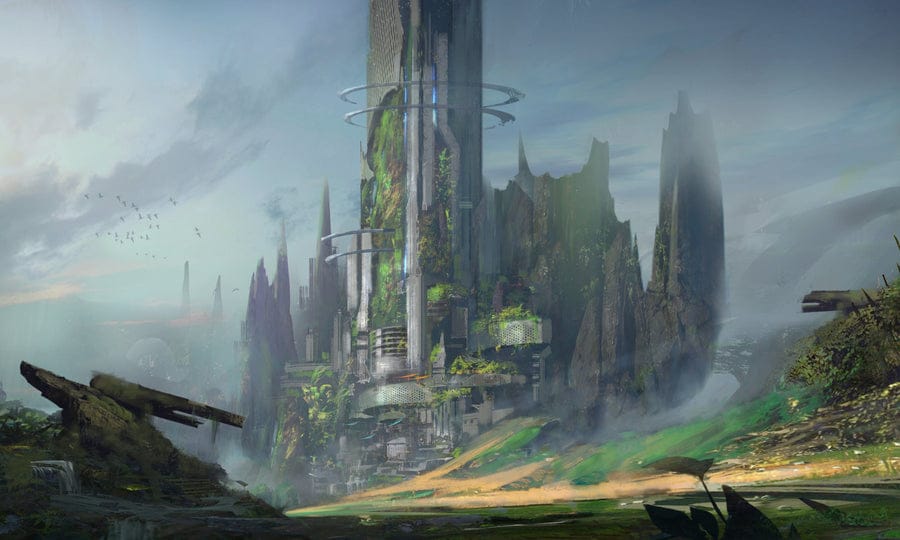
Despite the quantity of world building that went into developing Dreams and Machines, the team behind it seem sure that it wont be off-putting and the world should be as easy to get into as the system. Thanks to those murderous machines, most people are just trying to survive and lead unmurdered lives, so beyond the small community your characters may have grown up in the rest of the world is a tabula rasa, more rumour than fact, waiting to be uncovered.
Game sessions are divided into scenes so the action can zoom out as you cross the wilderness bringing much needed supplies from one settlement to another, or focus right in as the players defend settlements or brave the ruins of long dead cities, explore abandoned scientific facilities and generally try not to get eviscerated by the leftover malignant tech that isn’t always as dormant as you’d hope. A threat that despite the game’s more optimistic tone is certainly not out of the question.
‘I come from a generation where roleplaying characters die quickly,’ laughs Birch. ‘Metamorphosis Alpha is probably one of the extremes but you know, Call of Cthulhu is still there. But I actually like character death. Still there's a lot of mechanics here that encourage people to work together to use their spirit, kind of like your wounds, to do stuff and when people are out of spirit, other people can help you get up and you get XP from helping each other, which is like real life. I'm a big believer in that we all learn from when we're down on the ground and we pick ourselves up.’
Thankfully for those less enamoured with having to roll up new characters then Birch, character creation is quick and simple. ‘I think that’s a real strength of the system,’ says Bryce Johnston, the game’s Line Manager, ‘and because of that you can easily just run one shots with it, but there is a longer ongoing narrative within the setting. Chris talked about Kari, the little girl earlier, so we're going to follow her and you’ll be able to explore more of the world as you go on.
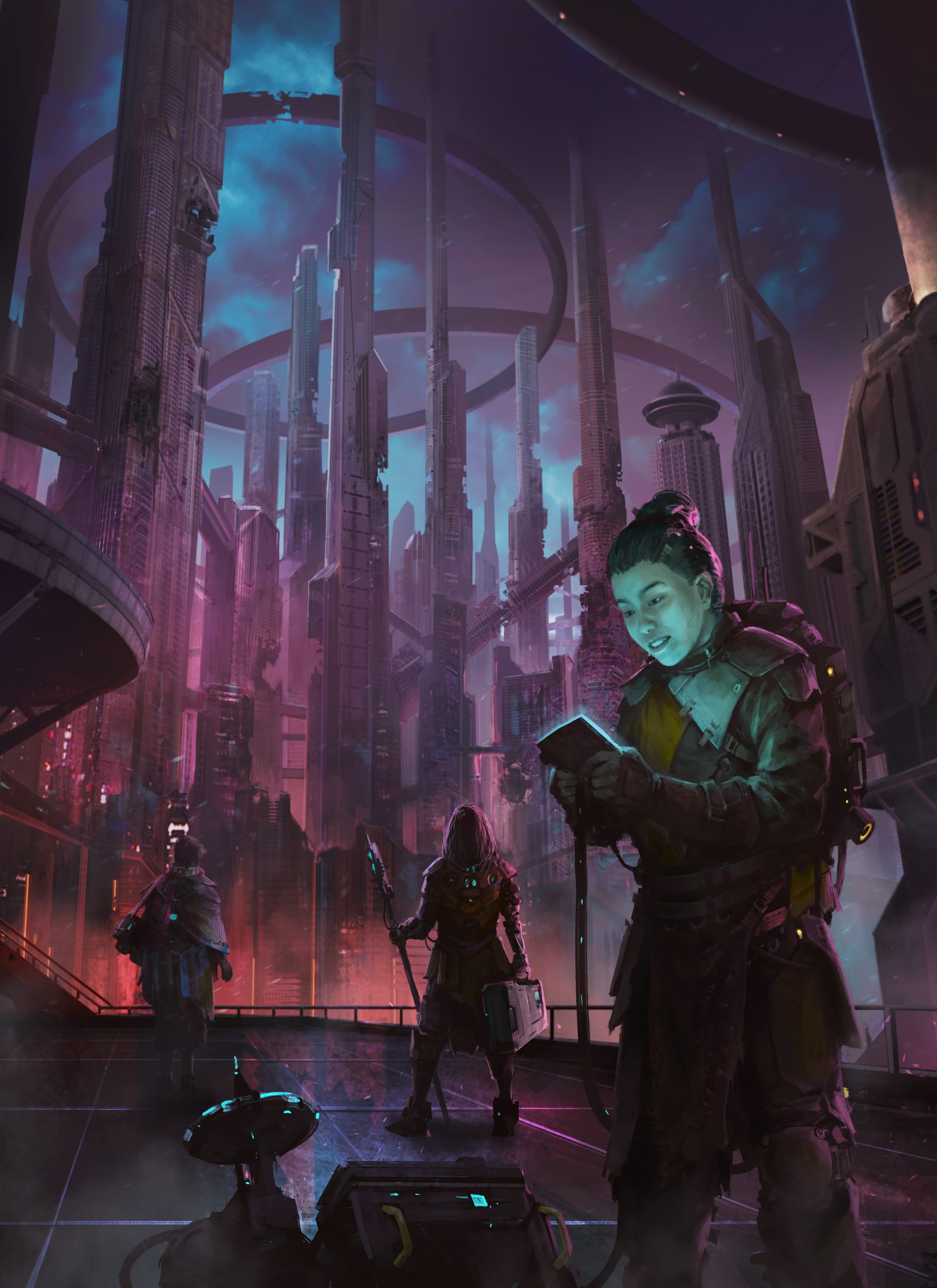
‘So if you want to make your character now or as soon as you get the Quickstart set and then carry that on for 10-20 years you absolutely can and we have a campaign book coming up that will be about exploring more of the map beyond what’s in the Player's and GM’s guides. We're going to really dig into the city of Emerta, which is this giant high-tech city far beyond anything that we can imagine today, but since the machines attacked there's just a few scavengers, some Spears, there struggling to find a way to keep on living in this decaying city.
‘So we're going to dive in there and there's a narrative that goes with it and it's gonna be really interesting and really fun to just explore more of this world. For me one of the bst things about Dreams is we have so many cool things we want to do, and right now a lot of it only exists as files on Google Drives, and it's going to be really fun to put that out there so people see the narrative develop.’
‘Each of the books will advance the narrative a bit in the background as there's a whole story arc with Kari and the robot she makes friends with,’ says Birch. ‘And they introduce new advanced archetypes for players and open up the setting with new locations, whether that’s underwater or even in space, and it builds up to a big finale. I like having an end to a story, I don't want it to be you like a TV series that just runs out of budget at some point. So there is a point where the story could finish up but then maybe a new story would open up.’
Those advanced archetypes just mentioned are classes only accessed when a player characters dies or, unusually for an RPG, retires, something the game explicitly includes rules for.
‘There's some little fun rules that if someone dies or if retires you get to remember them in game and you get some bonuses,’ explains Birch, ‘so the person whose character died maybe gets to pick one of the archetypes with better powers. But characters also have long term goals. I mean you don’t actually want to be adventuring, risking your life forever, maybe they want to settle down, that would be pretty normal right? It's an uplifting world but there's still a lot of danger and it's not an easy life, so why not just say, “Yeah, I've found enough money. I've got a farm. I know Julian in the village likes me. I'm gonna settle down.”
It’s an interesting addition for a medium that unlike Birch often seems scared of endings and also resolves something that for a game about communities is notably absent, mechanical rules for settlement building.
‘We were talking about settlement building in the game and I was like, think about it this way, the more of your party that retire into the village, the more reasons you have to go adventuring, maybe your Julie's having a baby or Eric's got married and there's a threat to his farm. And so there's a kind of narrative reason rather than a mechanical one. We've got ideas in the long run, but the initial idea was you shouldn't need mechanics to have these people exist in the background because you're incentivized to naturally let people retire or die.
‘With this hopeful sense of play around the game, I'd like to think that people will be like, “well, actually I want to protect those people in the community”,’ Birch concludes. ‘So what we're trying to do is build up this idea that it's a good thing for people to pass on, they might die as a sacrifice or just become part of the background of your community but that's a positive thing. You don't need to just hang on with dear life to this one character that you create.’
Dreams and Machines is out now, published by Modiphius