
Veni, Vidi, Ludo
Pack your dice-bags we’re going on a Roman Holiday as Ciro Alessandro Sacco takes us on a through the past and exciting present of the Italian RPG scene…
Pack your dice-bags we’re going on a Roman Holiday as Ciro Alessandro Sacco takes us on a through the past and exciting present of the Italian RPG scene…
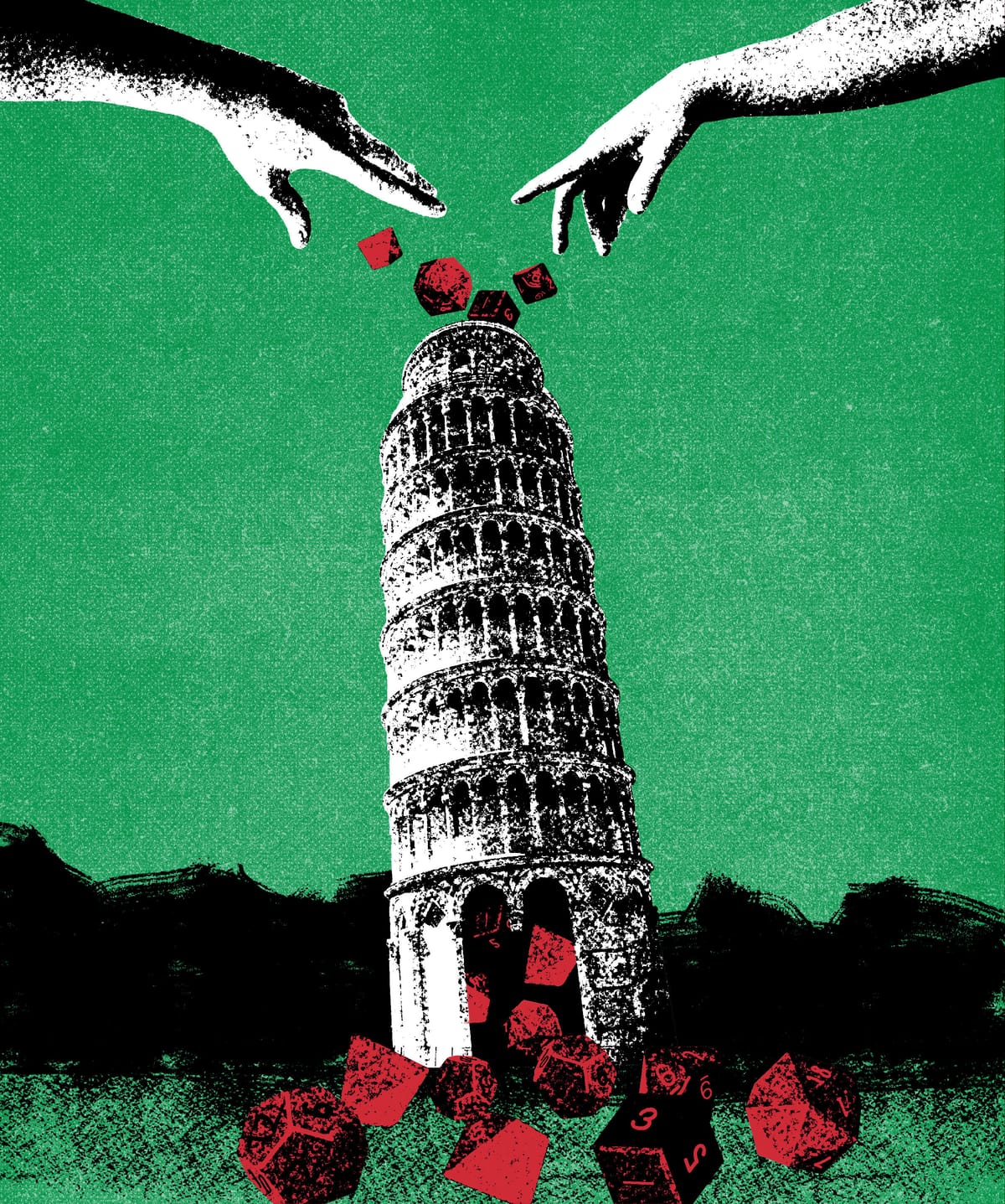
Until around 20 years ago Italy was never usually considered a major player in the tabletop gaming scene, but that all began to change with the global success of Emiliano Sciarra’s spaghetti western card game Bang!, released in 2003 and soon followed by the likes of Wings of War, War of the Ring and many others that found an eager international audience.
Since then there’s been an explosion of new boardgames, a new generation of publishers and more and more titles produced in multilingual versions and available overseas, firmly putting Italy on the board game map.
Sadly this was not the case with RPGs, where the rulebook is the game itself and not just one component that can be easily adapted for international editions. Apart from pioneers such as Asterion Press with their Quintessential series for Dungeons & Dragons 3.5 it was rare for even the best Italian RPGs to be translated into any foreign language, let alone English.
Over the past five years though, thanks to Kickstarter and the crowdfunding phenomenon, this situation has finally begun to change. This evolution has completely changed the equation and at long last many Italian publishers and designers groups are producing Italian and English language versions of both new RPGs and their D&D 5e campaign settings. Whilst the focus is still primarily on the not so big but familiar Italian market, Italian RPGs are starting to appear more frequently on people’s shelves and tables worldwide. But how did RPGs come to Italy?
As elsewhere in Italy there was an interest in wargames (or as we called them ‘simulation games’) and especially the new generation of these games that were being published in America in the 1960s and 1970s by companies like SPI and Avalon Hill. Imported by Italian companies you could find these games in toy and hobby stores and even occasionally big department stores.
These games were popular enough that many clubs devoted to military models and miniature wargames sprung up and they were often featured and reviewed in Pergioco, the very first Italian tabletop games magazine. But these wargames weren’t the only American imports and roleplaying games soon made their appearance too, and often in the same circles, a 1978 Italian military model magazine featuring an announcement from a group playing RuneQuest just a few months after the game had been first published in America.
Interest in these roleplaying games grew and grew and Pergioco soon started a D&D column whilst unofficial translations of books like the Advanced Dungeons & Dragons first edition Player's Handbook and Tom Moldvay's D&D Basic Rulebook began to appear. Whilst these translations were not of the highest quality, for example some spells received absurd names, Cure Light Wounds becoming The Light That Heals The Wounds, they nonetheless opened up these games to non-English speakers.
At the same time there were more and more student exchanges taking place and many an Italian student sent to the UK or US found themselves being dragooned into D&D sessions, only to return home as converts, keen to show off these amazing games to their friends and further spread the word.
The very first Italian company to produce wargames, and not just historical ones but games with fantasy and science fiction themes too, was International Team. Founded in 1979 they were truly ahead of the curve producing their games in multilingual versions and successfully exporting their titles back to countries such as the US and Japan.
In 1982 International Team would release two games that whilst being boardgames incorporated a lot of RPG elements, VII Legio, set in a future Solar Republic with strong Ancient Rome elements, and Magikon, where you play a group of adventurers who must enter a strange forest full of magic.
In truth VII Legio was originally conceived as a 'true' Science Fiction RPG but the company’s marketing department believed that Italy was not yet ready for such complex products. As it happens of the two it was VII Legio that sold quite well and to this day enjoys a cult status among gamers and collectors but it meant Italian gamers would have to wait just a little more for their first true homegrown RPG.
That breakthrough finally came in 1983, when Auro Miselli and Franco Tralli published I Signori del Caos (The Lords of Chaos), the very first Italian language RPG. Released through their own company Black Out Editrice, truthfully it was quite a crude effort, both in design and graphics, but it was a start.
Strongly influenced by AD&D, I Signori del Caos is a fantasy RPG set in the world of Arret, where in a somewhat Moorcockian fashion Chaos is the supreme power of the universe. Some of you might have spotted that Arret is the Italian word for Earth, Terra, reversed and likewise its geography is upended too, what is land in our world is sea in Arret, and vice versa.
Due to distribution problems and the scarce appeal of the product I Signori del Caos did not achieve much success in its day. Whilst it would eventually go through three different editions today its is almost forgotten if something of a collector's piece.
In 1984 though a second RPG, Kata Kumbas was released by Orion Editrice and this game was far better written and produced. Set in the wonderful lands of Rarte (this time an anagram of Terra) and the kingdom of Laitia (an anagram of Italia), Kata Kumbas presented a fantasy and picaresque version of Italy itself.
Notably Kata Kumbas did not use any Anglo-Saxon or Germanic fantasy themes, preferring instead to use as its source material Italian legends and folklore. The world of Laitia is presented as a somewhat medieval if magical land, featuring the summoning of demons and other extraplanar creatures, low levels of violence (combat is rather discouraged) and a nice dose of humour.
Alas, Kata Kumas did not meet with sales success as Bero Toys, its distributor and an important toy company, went bankrupt. Still it was a far better effort, was reprinted in a new and revised form in 1990 and still has a strong following here today. The original, boxed edition is perhaps the most sought after and costly Italian language RPG item ever, with complete copies going for upwards of 350 euros!
Of course whilst these homegrown titles were starting to appear D&D was still gaining popularity and the real Big Bang for RPGs in Italy would happen in 1985 with the release of the famous D&D Red Box by Editrice Giochi, at the time the biggest Italian mass market game company.
Editrice Giochi, who included such mega hits as Monopoly, Risk and Scrabble in its catalogue, were able to distribute The Red Box everywhere from toy, game and model shops to department stores and even supermarkets and so at a stroke created an entire new generation of gamers.
Alas in a familiar story the sales, albeit extremely good for a RPG, were not good enough for a publisher used to selling hundreds of thousands of copies of a single title in a year and it would be another three years before the much awaited Blue Box (Expert Set) was finally released.
Still the genie had escaped the bottle and the RPG market was now both established and growing. New specialist RPG magazines appeared, Crom first in 1989, soon followed by the likes of Rune, Kaos and Excalibur, whilst more and more games hit the shelves. both translations such as Call of Cthulhu in 1990 and AD&D’s Second Edition in 1993 and more original Italian creations like 1994’s Legione, the very first Italian language RPG about superheroes.
Whilst D&D and AD&D were – by far – the most popular RPGs here, this was a golden age for RPGs in Italy, one that sadly would only last until 1994 when the Italian edition of Magic the Gathering was released and suddenly everything changed.
The release of Magic the Gathering was Armageddon for RPGs in Italy. Over the next few years, with the exception of Stratelibri, who as it happened had the license for Magic the Gathering in Italian, every publisher stopped releasing both new games and expansions. Many of them would go on to fold, along with every gaming magazine, including the venerable Kaos who finally bid farewell with their 75th issue.
It was a hard period for RPGs and their, few, faithful fans and even Stratelibri who had maintained a trickle of RPG releases in the years between 1994 and 1997 went out of business too. It seemed that in Italy at least, RPGs were headed straight to the antiques market, fated to be the curious pastimes of a scattering of middle aged people.
It wouldn’t be until 1998 that we would start to see the first green shoots of recovery. That year a new publisher, 25 Edition, started printing the AD&D 2.5 core rulebooks with encouraging sales. With the big dog back on the scene the situation slowly started to improve with a trickle of new RPGs, both Italian and translated ones, being released again.
Whilst the print runs for the non-D&D games were far smaller, perhaps a quarter of that a publisher might expect pre-1994, new companies were appearing and the slow march to better times had begun. In 2003 there was even an Italian edition of both Dragon and Dungeon magazines launched too, something long held impossible, a sure sign of the scene’s return to health.
Today, like all around the world, RPGs in Italy are again experiencing a boom period thanks to a combination of RPGs making favourable appearances on TV and streaming shows like Stranger Things and Critical Role, a sense of 'computer fatigue' and, of course, the effects of the pandemic.
Dungeons & Dragons is still, by far, the most sold and most played RPG here, a situation only likely to be cemented with release of the new D&D movie (even 2000’s much maligned D&D movie was somehow a success in Italian theatres!), the long march to the game's 50th anniversary in 2024 and its new edition. Still there is a strong and growing interest in other RPGs such as Call of Cthulhu and Vampire the Masquerade here, alongside a vibrant Old School scene and, of course, another equally vibrant community of indie RPG fans.
On the homegrown front things are looking up too with titles such as Sine Requie, the most popular Italian RPG ever, and Lex Arcana, which for a period had the record for the most successful crowdfunding campaign for an Italian RPG, once again coming to the fore and Italian designed games reaching beyond our shores.
Alongside all this we now have a very active convention scene, with dedicated events like FabCon in the lovely city of Fabriano and RPGs once again a big presence at major pop culture conventions such as Play (almost 40.000 visitors in 2022) and Lucca Comics & Games (almost 320.000 visitors in 2022!). 2023 has even seen the succesful launch of our own new magazine, RoleZine, that is entirely devoted to RPGs, a sure sign if anything of the renewed health of the Italian scene and its promising future!
If you don’t know Italian but would like to dip your toes into the world of Italian RPGs then you’re in luck as, finally, more and more titles are being translated and made available for international audiences.
Here then are our suggestions of a few notable releases that all have, at least, English language quickstarts available and are well worth checking out!
First published in 1993, with the latest edition released in 2020, this venerable RPG is set in a Roman Empire that in the fifth century CE is still going strong though beset by dangers both mundane and supernatural.
Whilst ordinary menaces to the Empire are handled by the Roman legions, those of a spookier nature are dealt with by a special unit of the Pretorian Guard called the Cohors Auxiliaria Arcana, whose agents can be found in every corner of the Empire and beyond.
No prizes for guessing which group the players belong to.
Prima Vennero, now available in English under the name First They Came, is a GM-less indie RPG where the players take on the role of fugitives from Berlin in 1942, hunted by the Nazis for either political reasons, their ethnicity or sexual orientation.
Notably this RPG must be played with your eyes closed or blindfolded and it comes with a special audio track to help visualize the various part of the history. Designed for one shot games and obviously just for mature gamers, Prima Vennero has proven to be a very sobering as well as deeply original experience.
An original Italian RPG that is based on Japanese computer RPGs, Fabula Ultima lets gamers create their own worlds or recreate existing settings from your favourite games and embark on epic adventures.
Released in Italy in 2022 the game’s simple yet flavourful mechanics has led the to huge success both at home and abroad with the physical version of the English rulebook expected in shops very soon.
An RPG for fans of horror movies VHS has the unusual feature of three different core rulebooks each one devoted to its own genre of cinematic chillers.
Fans of slasher movies, à la Texas Chainsaw Massacre, should head for Bloodlust, Overplague is for recreating your favourite SF horror films such as Alien or The Thing, and the third book, Unchained, covers 'supernatural' horror like The Exorcist.
Whilst every rulebook is complete and independent they are also fully compatible with each other for when you want to throw yourself into the middle of the ultimate Xenomorph vs Freddy Kruger crossover...
There is, of course, a lot of Italian designed Dungeons & Dragons 5e material available with more new projects always being announced. Among the more intriguing ones there we’d recommend checking out:
Perhaps the 'grandaddy' of all the Italian 5E settings that have been translated into English, Journey to Ragnarok is set in a Scandinavian world which has entered an eternal winter which, the last step to the titular Ragnarok – the Nordic end of the world.
Take your place as a member of one of the six clans struggling for power as your search for power and adventure takes you to lands far beyond Scandinavia and even into the other Nine Worlds.
Set in the continent of Vesteria in the world of Gea, Historia has a dark Renaissance Europe feeling but with one notable difference, the protagonists are all anthropomorphic animals with over 50 different critters for players to choose from.
Complete with new backgrounds, classes and rules for firearms, Historia promises adventure, excitement, intrigues, corruption and mysteries to solve.
One of the most recent and indeed most successful Italian-made settings released for 5E, Brancalonia is appropriately set in an 'almost Italy' where the characters are mercenaries, ruffians and ne'er-do-wells, though often ones with a golden heart.
This ENNIE Award winning setting throws the players into a series of picaresque and morally questionable adventures, and takes a lot of influence from movies such as The Incredible Army of Brancaleone and Soldier of Fortune.
This feature originally appeared in Wyrd Science Vol.1, Issue 4 (April '23)